
Maintaining Mobility and Flexibility as You Age
By Daniel Quirk, PT, DPT, GCS
As we age, stiffness, aches, and reduced movement are often accepted as “just part of getting older.” But here’s the truth: losing mobility is not inevitable. With the right approach, you can stay active, independent, and confident doing the things you love for years to come.
At FOX, we believe one of the most powerful ways to support longevity and quality of life is through intentional movement. Without it, decreased mobility can make everyday activities like walking, golfing, gardening, traveling, or playing with grandchildren, feel more difficult or even out of reach.
Starting around age 50 and accelerating after 55, the body naturally undergoes changes in flexibility, joint mobility, posture, and balance. When movement begins to feel harder, many people unknowingly start moving less. Unfortunately, less movement leads to more stiffness, weakness, and limitation.
The good news? Mobility can be maintained and even improved at any age with consistent, intentional movement.
In this article, you’ll learn why stretching becomes more important as we age and simple, effective stretches you can start today to move with greater ease and confidence.
Why Stretching Matters More as We Age
Mobility is the foundation of independence and longevity. It allows us to walk safely, maintain balance, reach overhead, turn while driving, and move confidently through daily life. As we age, several natural changes occur:
- Muscles lose elasticity and become tighter
- Joints lose range of motion
- Posture tends to round forward
- Walking mechanics become less efficient
- Reaction time slows, making balance recovery harder
Left unaddressed, these changes can contribute to pain, fear of falling, and reduced participation in activities people love. Stretching helps counteract these changes by:
- Preserving joint range of motion
- Reducing stiffness and muscle tension
- Improving posture and walking mechanics
- Supporting balance and coordination
- Making everyday movements feel easier
At FOX, we focus on movement that supports real life, not just exercise for exercise’s sake. Stretching helps prepare your body for the movements you perform every day.
How Often Should Adults Over 55 Stretch?
Consistency matters more than intensity. Stretching should feel restorative—not exhausting.
- Aim to stretch most days of the week (at least 3 days/week)
- Hold each stretch 30-60 seconds
- You should feel gentle tension, not pain
- Stretch after light movement (like walking)
6 Essential Stretches for Aging Well
These stretches target the areas that most impact walking, posture, and balance. Each can be performed safely at home and modified as needed.
1. Wall Angel Stretch
Why it matters: As posture changes with age, many adults develop forward rounded shoulders and a stiff upper back. This limits overhead reach, breathing efficiency, and shoulder mobility.
How it helps: Wall angels improve shoulder mobility, posture, and upper back movement—key for reaching, lifting, and standing tall.
How to do it: Stand with your back against a wall, feet a few inches away. Keep your head, upper back, and hips lightly against the wall. Start with your elbows bent at shoulder height and slowly raise and lower your arms like making a snow angel, staying in contact with the wall as much as possible.
2. Calf Stretch
Why it matters: Ankle and calf stiffness is closely linked to balance difficulty and increased fall risk. If ankles don’t move well, the body struggles to adapt to uneven surfaces.
How it helps: Improving calf flexibility supports smoother walking, better balance reactions, and greater confidence on your feet.
How to do it: Face a wall, countertop, or use the stairs. Step one foot back, keeping the heel down. Gently lean forward until you feel a stretch in the calf of the back leg. Switch sides.
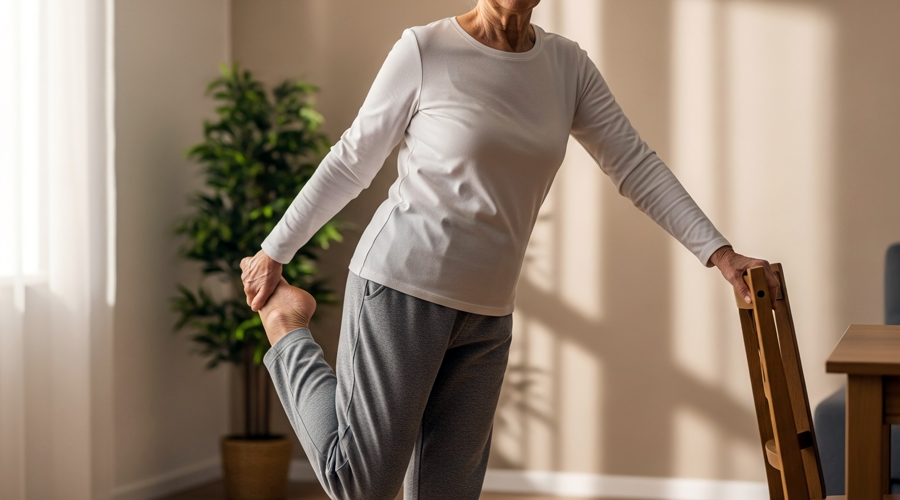
3. Standing Quad Stretch
Why it matters: Tight quadriceps can limit knee motion, interfere with walking, and make stairs and rising from chairs more difficult.
How it helps: Stretching the quads supports knee health, smoother walking, and ease with daily transitions.
How to do it: Stand holding a sturdy chair or countertop. Bend one knee and bring your heel toward your buttock, holding your ankle or pant leg. Keep your knees close together and chest upright. Switch sides.
4. Thoracic Spine Extension Stretch
Why it matters: Loss of mobility in the upper spine contributes to rounded posture, neck strain, and balance challenges.
How it helps: Thoracic extension improves upright posture, breathing, and upper body movement.
How to do it: Stand facing a countertop or stair banister. Holding onto your support, bend forward at the hips keeping your spine flat until you feel a stretch. Avoiding rounding of the spine is key for this stretch.
5. Hip Flexor Stretch
Why it matters: Hip flexors shorten with prolonged sitting and aging, pulling posture forward and shortening stride length.
How it helps: Stretching the hip flexors supports upright posture, efficient walking, and reduced low back strain.
How to do it: Hold a countertop or chair. Step one foot back into a gentle lunge. Keep your chest tall and shift your weight forward slightly until you feel a stretch in the front of the back hip. Switch sides.
6. Hamstring Stretch
Why it matters: Tight hamstrings make bending, stair climbing, and getting up from chairs more difficult.
How it helps: Improved hamstring flexibility supports smoother movement and reduces unnecessary strain on the lower back.
How to do it: Sit tall on a chair. Extend one leg with the heel on the floor. Gently hinge forward at the hips while keeping your back straight. Switch sides. If able, complete standing using a stair to elevate your straight leg and stretch the hamstring as you gently hinge forward at the hips.
These stretches don’t just improve flexibility. They directly support everyday movements like getting out of a chair, stepping off a curb, reaching overhead, and turning safely while walking or driving.
When Extra Support Makes a Difference
While these stretches are a great place to start, many adults find that having guidance, support, and consistency makes all the difference. That’s where Mobilize by FOX Wellness comes in.
Mobilize by FOX Wellness is designed specifically for older adults who want to stay mobile, reduce stiffness, and maintain independence as they age. It goes beyond basic stretching by combining guided, assisted movement with real-life functional goals delivered one-on-one in the home by a FOX Fitness Specialist.
Each session is:
- Tailored to your unique needs and goals
- Focused on improving real world mobility, not just flexibility
- Monitored through functional mobility testing, so progress is measurable and meaningful
- Supported with assisted stretching at every visit, helping joints move more freely and safely
- Reinforced with a personalized home stretching program, so benefits extend beyond the session
Mobilize by FOX Wellness is an ideal complement to strength or endurance-based wellness programs. Strength builds capacity, but mobility allows that strength to be used effectively. Together, they support smoother movement, better posture, reduced pain, and lower fall risk.
The Bottom Line
Aging doesn’t have to mean slowing down. With consistent movement, intentional stretching, and the right support, you can continue doing the things you love with confidence and ease. At FOX, our mission is simple: to believe in the strength of people – and their ability to achieve what they once thought impossible.