
The Key to Staying Strong, Independent, and Active as You Age
By Daniel Quirk, PT, DPT, GCS
If you’ve ever found yourself out of breath walking up a steep hill, carrying groceries inside, or chasing grandchildren around the yard, you’ve likely bumped up against the limits of your VO₂ max. Most people have never measured theirs—yet this single metric is a strong predictor of long-term health and lifespan. In fact, it can be more predictive of all-cause mortality than smoking status, blood pressure, diabetes, or high cholesterol. Because of this, the American Heart Association now advocates for VO₂ max to be recognized as a clinical vital sign due to its powerful link to overall health.
What Is VO₂ Max?
VO₂ max is a scientific term that describes the maximum amount of oxygen your body can use during intense exercise. The higher your VO₂ max, the better your heart, lungs, and muscles work together to support activity. Think of it like the size of a car engine: a larger engine produces more power and efficiency. Similarly, a higher VO₂ max means your body can do more work with less strain. Alongside muscle mass and strength, VO₂ max is now considered one of the top predictors of healthy aging.
How to Measure VO₂ Max
VO₂ max can be measured directly in a clinic or exercise physiology lab (the gold standard), but there are also simpler ways to estimate it and track progress over time.
1. The Cooper Test
Run or walk as far as you can in 12 minutes on a track or treadmill.
Enter your distance into an online Cooper Test calculator to estimate your VO₂ max.
2. The Queens College Step Test
Using a 16.25-inch step, perform a step-up pattern for 3 minutes at:
- 24 steps/minute for men
- 22 steps/minute for women
Immediately after finishing, measure your pulse for 15 seconds and use an online calculator to estimate your VO₂ max.
3. Smartwatches
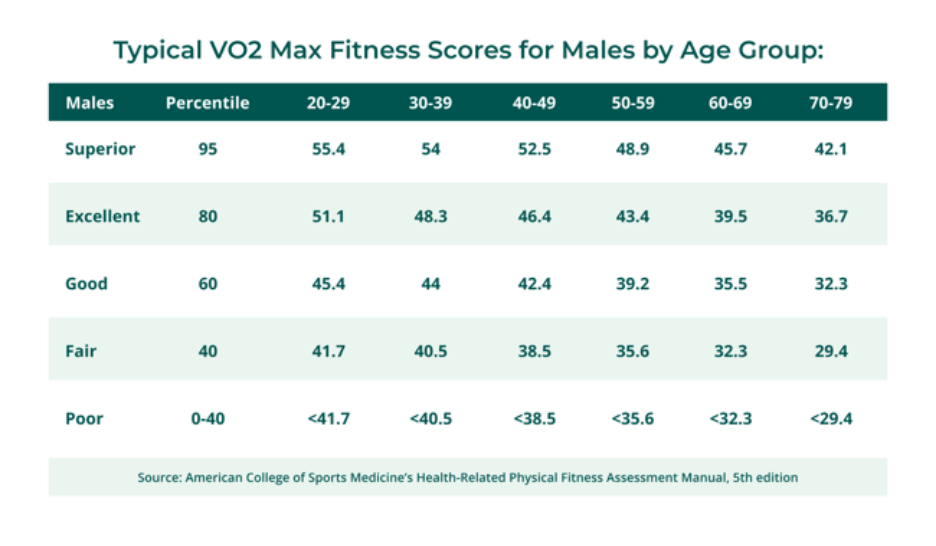
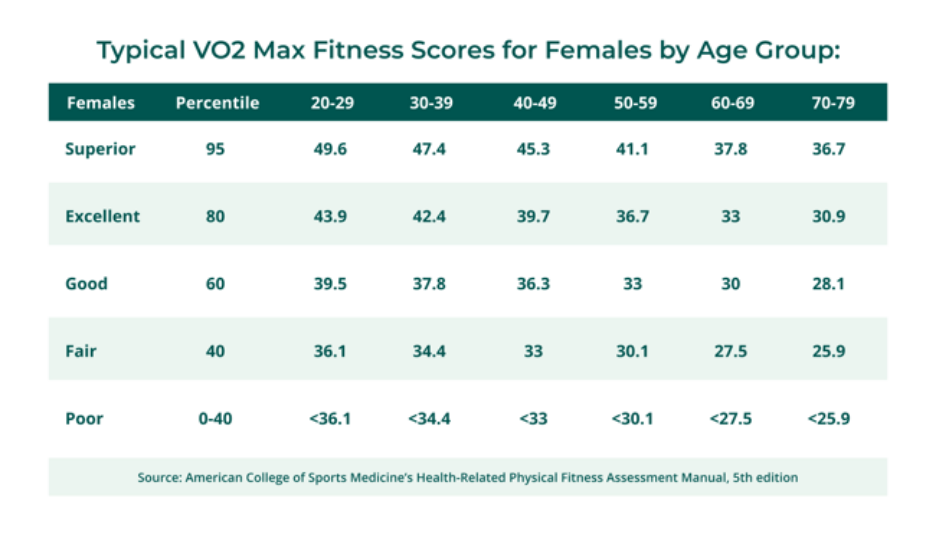
Devices like Apple Watch, Garmin, and Fitbit estimate VO₂ max during walking or running workouts. These estimates aren’t as precise as lab tests, but they help track trends over time.
How to Improve VO₂ Max
If you’re worried your VO₂ max isn’t where you’d like it to be, the good news is that it can improve at any age—even into older adulthood.
Even better, the biggest gains in longevity come from moving from “poor” to “fair.” According to the AHA, about 50% of the benefit of improving VO₂ max comes from this initial improvement alone.
1. Zone 2 Training
The CDC recommends 150 minutes per week of moderate-intensity aerobic exercise—also known as Zone 2. Examples include:
- Brisk walking
- Hiking
- Swimming
- Stationary biking
- Elliptical training
Breaking this into five 30-minute sessions works well for most people.
How to determine Zone 2:
- Rough estimate: 185 – your age
- Talk test: You can speak in short sentences, but breathing is deeper and slightly labored
Zone 2 builds your aerobic base, improves metabolic health, and lays the foundation for higher-intensity training.
2. The Norwegian 4×4 Workout
Once you’ve built a baseline with Zone 2, the 4×4 method is a research-backed way to significantly boost VO₂ max.
Here’s how it works:
- Warm up for 10–15 minutes
- Complete four intervals of 4 minutes each at 90–95% of your maximum heart rate
- Estimate max HR: 220 – your age
- Estimate intensity: RPE 9/10 (very hard, but sustainable for 4 minutes)
- Recover for 3 minutes between intervals at RPE 6/10
Choose any aerobic activity you prefer—running, hiking, cycling, swimming, rowing, or elliptical.
How FOX Wellness Can Help
Improving VO₂ max later in life requires more than generic fitness advice—it takes professional guidance, individualized progression, and accountability. That’s where FOX Wellness plays an important role. Our programs are built specifically for aging adults, focusing on safe, sustainable aerobic training that drives real improvements in cardiovascular fitness.
1. Personalized Aerobic Training Plans
Every client begins with comprehensive fitness testing performed by a FOX fitness specialist. This may include submaximal testing (such as the Six-Minute Walk Test, step tests, or smartwatch VO₂ trend review) to establish an aerobic baseline. From there, we design a customized Zone 2 training program with target heart rate ranges, weekly structure, and activity recommendations based on ability level and available equipment.
2. Guided Interval Training to Boost VO₂ Max
As clients build an aerobic foundation, FOX Wellness specialists introduce structured interval workouts—like the Norwegian 4×4, hill repeats, or progressive tempo walking. These sessions are carefully monitored to ensure older adults reach appropriate intensity without overexertion or risk of injury. This is where we often see some of the most meaningful improvements in VO₂ max, even in adults in their 70s and 80s.
3. Strength Training to Support Aerobic Capacity
Maintaining VO₂ max also depends on muscle strength, especially in the legs. FOX Wellness incorporates functional strength training to improve gait, walking efficiency, and power output—all of which help make aerobic exercise feel easier.
4. Mobility and Posture Work to Improve Breathing Efficiency
Our “Mobilize by FOX” sessions support thoracic mobility, posture, core strength, and rib cage expansion. Clients often notice that breathing feels easier and movement feels smoother, which supports longer and more effective aerobic sessions.
In short, FOX Wellness provides the testing, structure, expertise, and support aging adults need to improve VO₂ max safely—and, with it, longevity and quality of life.
The Bottom Line
If you want to maximize health span, maintain independence, and improve quality of life as you age, aerobic fitness should be a priority—and VO₂ max is one of the most powerful measures available. Tracking your VO₂ max and working to improve it is a proven strategy to support longevity and vitality.
Since VO₂ max naturally declines with age—even in very fit individuals—the best time to start improving it is today. While these strategies are effective, working with a fitness specialist experienced in training older adults can help ensure safe, personalized, and sustainable progress.