
Benefits of Resistance Training in Older Adults
By Carl Haynes, PT, DPT
Physical Therapist
One of my favorite sayings that I heard from another physical therapist is “There is nothing wrong with getting strong.” One of the hardest parts of working with older adults is knowing when to challenge them and when to pull back on how we challenge them. I believe that teaching them about strengthening and how that affects balance and mobility is key for buy-in and engagement. As clinicians, we can read papers and charts and understand the basics of progressing exercises but we need to tailor that to our patients’ needs and motivations. We have to understand that even though many of our patients are dealing with generalized weakness and many of the same diagnoses, all our patients are unique and we have to approach everything that way. There are various ways to find the right resistance for our patients, including using 5 or 1 rep max tests and then working at 70-80% of that weight, using RPE to find a moderate to moderately- hard challenge, or seeing how many they can lift or move a certain weight until they get tired.
Progressing Strengthening Exercises
The question for clinicians is how do we challenge our older adults to get into resistance training in their homes? The challenge with going into patient’s homes is that they may not have adequate weights to challenge them, so we need to get creative and find heavy items around their home that we can use to challenge them. Have the patient lift something heavy and see how many lifts they can perform and if it is easy or difficult. If it’s easy, find something heavier; if it is hard, have them do 8-12 reps to help determine progressions.
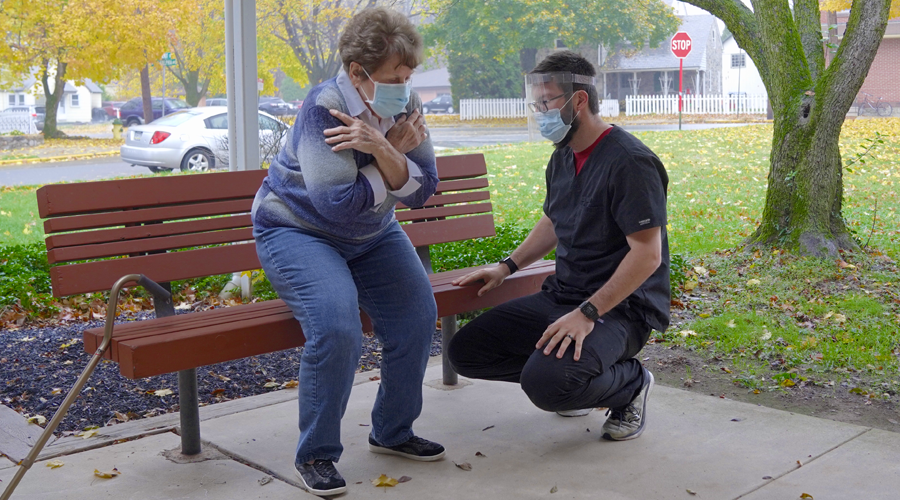
For many of our patients in the frail state, minimal resistance is hard, so finding the right TheraBand or ankle weight is appropriate. Use the same methodology as above to progress them. Once they can do a couple of sets at 8-12 reps, it is time to increase resistance. For LE exercises, one way to modify resistance is to start with weights or bands higher up—closer to the knee or hip—and then progressing down the leg. For example, doing knee extensions starting with resistance just below the knee, then moving it down towards the ankle is an easy progression. If it is possible, tying the band to a table leg can provide easy access for the patient and can be beneficial for compliance as set up is easier. Using bodyweight exercises such as squats or wall push-ups is another good way to get proper resistance. Sit-to-stands can take the place of squats as well, and using chairs of different heights or having patients hold weights when able to do so without using their arms to push up is an excellent way to build up strength. On top of that, once they can hold weights, having them move the weight away from their body is an extra challenge. This shows the patient how well they can transfer and gives them more confidence with their balance. Taking away UE is good for balance but also good for strengthening and stabilizing muscles in the lower extremities and easy for patients to progress on their own.
Creative Alternatives to Building Strength
Again, we must be creative with what we use for strength training in-home or in our senior living communities. A few examples that are typically accessible include canned goods, milk jugs, and grocery bags, which are particularly good since they have handles. If the patient has good balance but uses a rollator walker, I like to put weights on their walker seat, lock the brakes, and have them push the walker around like a sled for LE and UE strengthening. Recently, I had a patient who injured her back lifting a box of Christmas decorations, so I used various weights in boxes of different sizes and instructed the patient to work on picking up and putting them down or carrying them around. This should build up her tolerance to an activity so that in the future her body will be resilient to that activity.
If we want what is best for our patients, we need them to understand the importance of strengthening for overall safety and mobility using whichever methodology is best suited for each patient. Some may not fully understand RPE or may not be able to get 5 or 1 rep max testing done. Use your best judgment by watching the form or for signs of fatigue. To paraphrase a poster in our wellness center, every age is the right age to get strong.