
When Rehab Isn’t Enough: How FOX Stronger Living Improves Functional Wellness
By Allison Cohen, PT, DPT, FSOAE
Senior Director of QAPD, Director of FOX Optimal Living
Amid the COVID-19 pandemic, the senior living industry is facing challenges. Occupancy rates are at an unprecedented low, and residents are more sedentary than before. It is now more important than ever that we facilitate aging in place so that residents don’t need to move out for higher levels of care.
In the World Report of Ageing and Health, The World Health Organization describes the maintenance of functional ability as the most important physical attribute for successful population aging. This means it is paramount for your residents to have access to services that impact functional wellness. So paramount that it could result in a 33% decrease in falls, a 38% decrease in hospital admissions, and an increased length of stay in your community.
The Senior Living resident population is clinically complex. 40% suffer from Alzheimer’s Disease, 23% from depression, 46% from cardiovascular disease, and 17% from diabetes. As older adults live longer as a result of modern medicine, we expect this complexity to increase. Due to clinical circumstances, functional deficits are prominent. 62% of residents need assistance with bathing, 29% with walking, 47% with dressing, 39% with toileting, 30% with transferring to/from the bed, and 20% with eating.
As an operator, the silver lining is in your hands. You have the ability to directly impact the functional wellness of your residents by facilitating access to outpatient rehabilitation and wellness in the comfort of your community. Here are a few methods senior living operators can use.
Improve Residents’ Functional Wellness Through Medicare Part B
Medicare Part B, the insurance that pays for outpatient services, covers physical, occupational, and speech therapy services in the home of older adults. These services are the same as those delivered in outpatient clinics – and produce identical, if not better, outcomes. It is common to confuse these with Home Health Services, which are covered by Medicare Part A. These services are also provided in the home, but differ in frequency, duration, and functional impact.
Why Is This Distinction Important?
Science shows that older adults require 12-16 weeks to improve strength, 50 hours of balance training to protect against falls, and 150 minutes of moderate-intensity exercise per week to maintain aerobic fitness. Do your residents currently engage in this?
As a Geriatric House Calls practice™, FOX Rehabilitation partnered with OptumLabs and Optum Advisory Services to analyze its data. OptumLabs is a CMS Qualified Entity that evaluates provider performance to enhance the quality of healthcare. This third party analysis was staggering and supported the need for access to outpatient therapy services in Senior Living communities – it looked at 10,145 senior living residents who received Medicare Part A or Part B therapy services at home.* The group that received Part B services were found to have significantly fewer hospital admissions and shorter SNF stays.
When Rehab Isn’t Enough
Ever wonder what happens to a resident after a bout of rehab? With therapy, residents become stronger, more stable, and more able – but how long does this last?
Literature shows that older adults require a high level of properly dosed exercise to maintain gains achieved in therapy and prevent new onset of functional decline. Each week, older adults require 150 minutes of moderate-intensity exercise to maintain aerobic fitness and 120 minutes of balance activities to maintain stability. Additionally, all major muscle groups must be strengthened and stretched 2 to 3 times per week to maintain muscle performance.
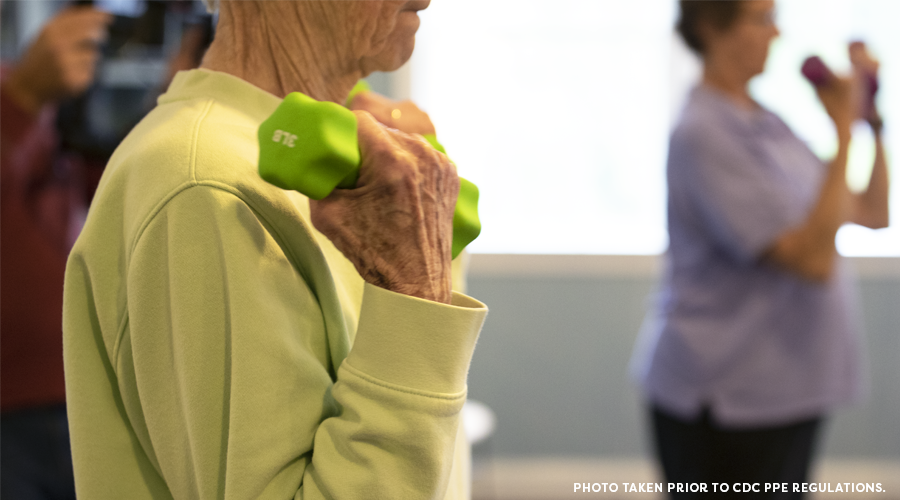
Recognizing the needs of older adults – beyond restorative rehab – FOX has developed an innovative wellness continuum called FOX Stronger Living. This evidence-based model engages senior living residents year-round in progressive, intensive, and individualized exercise programs that reduce falls and hospital admissions.
How FOX Stronger Living Supplements Rehabilitation
Our Stronger Living clinical team looks at 18 indicators of functional decline at baseline, every quarter, and in response to events like falls or change in status. Based on these metrics, residents are placed into functional tiers and provided the opportunity to achieve 150 minutes of moderate-intensity exercise and 120 minutes of balance training per week. This volume and intensity are recommended by the American College of Sports Medicine and supported by the American Heart Association, CDC, and American Geriatric Society.
With FOX Stronger Living, we see residents experience a 24% improvement in balance, a 26% increase in lower body strength, and a 21% increase in gait speed over 12 months of program exposure. This leads to 33% fewer falls, and 38% fewer hospital admissions.
Take JH, for example. He moved into his community 9 years ago and has had access to FOX Stronger Living since 2016. After 4 years of consistent participation in evidence-based wellness programs, JH proudly celebrated his 100th birthday last month with no wheelchair or walker. He is thriving in the community, admired by staff, and is an inspiration to fellow residents.
Today’s older adults are demanding personalized, high-quality services and amenities. Access to onsite therapy and wellness programs can improve both your customer’s perception of value and, more importantly, the functional wellness of residents. It is clear today, more than ever before, that engaging in high-quality programs will decrease falls, decrease hospital admissions, and increase the length of stay.
*Based on Advisory Board and Optum Advisory Services analysis of CMS’s Standard Analytic files. Medicare FFS data only. Results are based on the 100% beneficiary sample that is contained in CMS’s SAF Carrier file.