
A Caregiver’s Struggle To Revive Their Loved One’s Independence
By Bradley Pennypacker
Director of Quality Assurance and Business Administration
I grew up on my grandparents’ farm. If there is one thing they have taught me, it is that hard work and determination pays off.
I remember my grandmother after breakfast one morning saying: “If you have time to lean, you have time to clean.”
She was, and very much still is, a tenacious, strong-willed woman who would do anything for those she loved.
During my break between undergraduate and graduate school, she reached stage 4 Parkinson’s Disease with onset dementia. It was disheartening to see someone I loved struggle and suffer so much.
I decided to come back home and take care of my grandmother, which in my mind meant to enable her to revitalize her independence. I was incredulous to the fact that she could not get better.
When I returned home, I met with her care team: a physical therapist and a certified registered nurse. They had gone through the treatment plan with me for my grandmother’s weekly exercise schedule, among other things.
What I learned
As a caregiver, I learned it is critical to incorporate exercises for the mind, body, and soul into our daily routines.
This allows us to encompass a holistic approach to caring for my loved one.
This means making sure that we are providing healthy and appropriate food, especially if your loved one has diabetes, high blood pressure, or any other chronic health condition that would require a dietary constraint.
We must make sure that we incorporate activities that the person we’re caring for loves to do. Music and reading are great choices to stimulate the brain. It is better than watching countless hours of “American Pickers” or “Antiques Roadshow.”
How I Implemented What I learned
I had incorporated all of these items into my plan. It was a great feeling. I knew that, with her work ethic and my determination to get my grandmother back to her deserved independence, her life would soon get better.
Little did I know that life is just not that simple.
There was such a strong emotional connection between my grandmother and me. When I tried to get her to do her exercises, she had started crying and said, “I can’t do this.” This was the most challenging aspect of working towards my grandmother’s independence.
When the physical therapist came back the next day, he had gone through my grandmother’s daily exercise activities with her and my grandma was very compliant. In fact, she did not complain or express concern once.
I was astounded by what I had witnessed. The physical therapist and I did the same activities, but our results were wildly different.
I suddenly realized the difference was the approach.
The physical therapist was objective and pushed my grandmother to succeed in her activities. I, on the other hand, was more emotional. As a result, my grandmother leveraged my moment of weakness to console and comfort her.
This is not what she needed.
I realized that I would have to deter myself from getting too emotional and be strong so that she could leverage my strength instead of my moments of weakness.
The next day, I turned on music, put down a strip of tape on the ground 10 feet away from her chair and said with a stern voice, “Okay, Grandma, today you are going to get up and walk to this line”.
I distracted her by saying things like: “Wow, the radio is playing some good music today, isn’t it?”
My grandmother lifted herself up out of the chair without my assistance, placed her hands on her rolling walker and proceeded to walk towards the line. I continued to hold a conversation to distract her from the task at hand.
My grandmother had reached her destination.
I knew that in order for my grandmother to get better, I needed her to face the struggles she was having with her Parkinson’s. Now that she was at the line, I asked her to step over the line.
People with Parkinson’s disease often have difficulty walking, especially stepping up due to the decrease of dopamine production in the body. This is a critical chemical needed for movement.
I refocused my grandmother’s attention on the music once more and asked her again to step over the line.
She was successful.
I had now found a way to bridge the gap between the loving relationship we had so that I could be more objective in helping my grandmother, at the very least, manage her chronic and debilitating disease.
A Final Thought
My advice to all caregivers out there is to never give up on the loved one you care for. Find a method that works for you and continue on the path to making your loved ones strong again.
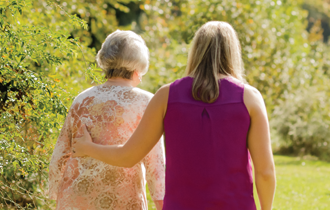
The people featured in the photo are real FOX clinicians and patients. However, they are not referenced in this article.