
Making Senior Living Home With Collaborative Care
By Sue Esposito, PT, DPT, NCS, GCS
Regional Quality Assurance Liaison
I believe the director of a senior living community has the power to directly influence every resident’s experience within their community. The SLC directors that have a vision, a commitment to make each resident, staff member, and outside professional feel they are part of a team, feel they are all working towards a common goal and will likely be most successful.
I have heard countless residents state that moving to a senior living community is the best thing they have ever done and regret not making a move sooner.
I have also heard many residents claim the transition to the senior living community was a mistake.
Why is the experience of senior living communities positive for some yet a regretful decision for others?
What I feel every resident yearns for is a place to call home, where they can live as they please and function to their best potential.
Residents want to feel important. They want to feel they have a place in this world.
How can we provide an atmosphere that is safe but at the same time allows the residents to make their own decisions?
One of the secrets to this question is good, consistent collaboration with the therapy team and the senior living staff that are involved in the care of each resident. The SLC director is also an integral piece in setting the foundation of this optimal environment to live and work in every day.
Communities that have these strong-knit relationships are the most successful communities in the industry. The benefit of this close partnership between the therapy team and the senior living staff directly affects the residents and their experience within the community.
As therapists, we have the opportunity to spend a significant amount of one-on-one time with the residents: We get to learn quickly what they like and dislike. We work countless hours, striving to make them as strong and independent as possible.
The challenge is to ensure there is carryover outside of therapy. The only way this is possible is through caregiver training and education.
What does caregiver training, education, and collaboration look like?
The impact that caregiver education and training can have on a resident’s life is indescribable. When we work in an environment that prioritizes caregiver education, training, and collaboration, everyone wins.
Therapists are experts in mobility, cognitive management or remediation, and education. We can train the caregivers on various techniques to make their life easier.
I have seen with a dedicated team of caregivers and therapists, that the caregivers are reporting less work-related injuries, decreased stress, and improved job satisfaction. I have seen that the turnover rate in communities with this type of a team approach is much lower than communities that don’t prioritize a partnership between the therapy team and the senior living staff.
The senior living communities that have these partnerships are in constant communication with one another: They are often bouncing ideas off one another to solve various challenging situations. Through this partnership, resident care is inevitably improved. Caregivers can now understand behavior management strategies, redirection skills, safe resident handling skills, and have the ability to empower the residents to be as independent as possible.
What does this mean for older adults?
All residents deserve clinically-excellent care. When this type of environment is evident, not only do the residents feel it, but the staff, therapy team, and visitors can sense this unique environment.
Residents know that they are in a nurturing community that feels like home.
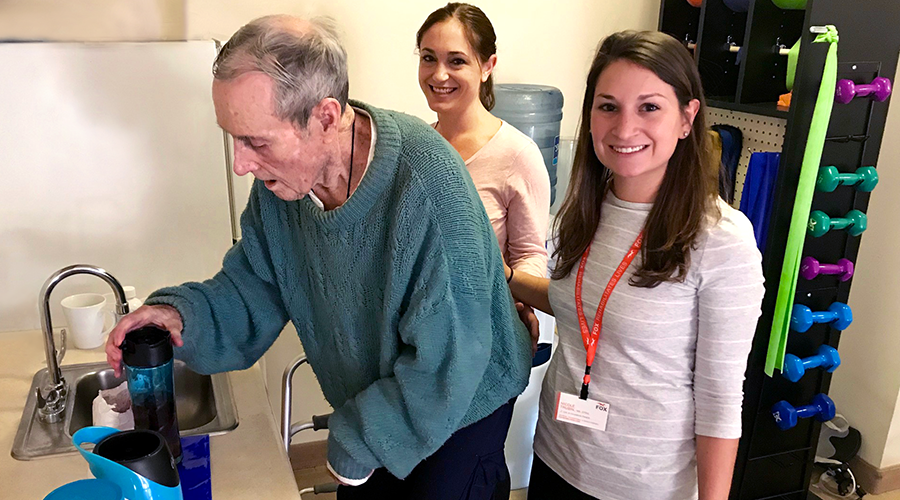
While the people in this photo are real FOX clinicians, patients, and partners, they are not mentioned in this article.