
Beyond Balance: Dynamic Strength for Fall Prevention
When discussing fall prevention for adults over 50, standard advice almost always centers on environmental modification: clearing cluttered hallways, removing loose throw rugs, improving indoor lighting, and installing bathroom grab bars. While these precautions are a vital first step in making a home safer, environmental fixes address only one side of the equation.
Home modifications assume you can control your environment. They don’t account for what happens when you step out into the real world, where unexpected drops off a curb, uneven sidewalks, dim outdoor lighting, or hidden obstacles are completely out of your control.
In those critical split seconds when a trip or stumble occurs, hazard removal is no longer an option. What keeps you upright and safe is your body’s dynamic stability—its ability to sense a sudden shift, activate key muscle groups, and catch itself before hitting the ground.
The Invisible Threat: Sarcopenia and Slower Neuromuscular Response
As we age, our bodies undergo a natural decline in muscle mass, strength, and explosive power—a condition known as sarcopenia. While sarcopenia is often discussed in terms of general frailty or difficulty carrying groceries, its most dangerous consequence is its impact on reactive movement.
Regaining your balance after an unexpected trip isn’t just about raw muscle power; it is about neuromuscular reaction speed. When your foot catches on an uneven surface, sensory receptors in your joints and inner ear send an immediate distress signal to your brain. Your nervous system must then instantaneously route signals back down to your muscles to adjust your center of gravity.
As muscle fibers shrink and neural communication slows with age, the body takes longer to register a loss of balance and execute a corrective step. Without sufficient fast-twitch muscle fibers and rapid neural firing, your body lacks the physical momentum and speed required to arrest a fall in progress.
Beyond Static Balance: Why Standing on One Leg Isn’t Enough
Traditional fall prevention exercise programs often place a heavy emphasis on static balance exercises, such as standing on one foot or tandem standing (heel-to-toe). While these exercises are excellent for establishing baseline postural control and body awareness, real-life falls rarely happen while standing perfectly still.
Real-world stability is dynamic. A stumble throws your weight far outside your base of support, forcing your body into an abrupt, unpredictable motion. To recover, your physical training must target two critical physical components:
- Lower Body Explosive Power: Strong hips, thighs, and calves give you the structural leverage to throw a leg out rapidly and wide, re-establishing a stable base before your momentum carries you down.
- Upper Body Push Strength: If a forward trip occurs too fast for a corrective step, your default protective reflex is to reach out with your arms. Having strong shoulders, chest, triceps, and core muscles allows you to absorb impact, brace effectively against a wall or ground, and interrupt downward momentum.
The Overlooked Role of Upper Body Push Strength
Upper body strength is frequently omitted from fall prevention protocols, yet it is one of your primary lines of defense during an accidental stumble. When you lose your balance forward or sideways, your brain instinctively signals your upper limbs to extend.
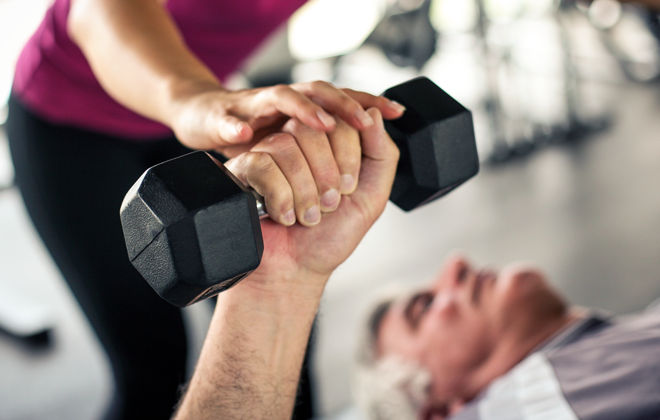
If your upper body lacks functional pressing strength, your arms may collapse under your body weight, leading to severe impacts on the wrists, shoulders, facial structure, or hips. Building upper body push strength—through targeted movements like wall push-ups, incline presses, chest presses, and plank holds—prepares your upper kinetic chain to absorb sudden kinetic forces safely.
When paired with reactive lower body stability, strong arms and shoulders turn an inevitable fall into a manageable stumble.
Restoring Confidence and Breaking the Fear-of-Falling Cycle
Beyond the physical mechanics, there is a powerful psychological component to fall risk: the fear of falling itself.
After experiencing a minor trip, loss of balance, or a near-miss, many older adults develop an understandable anxiety about falling. Unfortunately, this fear often leads to self-imposed activity restriction. People begin avoiding stairs, stepping around uneven terrain, or staying indoors altogether.
This reduction in movement triggers a dangerous downward spiral:
- Reduced daily activity leads to accelerated muscle loss (sarcopenia).
- Less movement degrades joint flexibility and spatial awareness.
- Decreased strength and coordination make future stumbles more likely.
- Higher fall risk further increases the fear of moving.
Structured strength, balance, and reactive training breaks this vicious cycle. When you train your body to handle sudden weight shifts in a controlled environment, your brain rebuilds trust in your physical capabilities. Restoring movement confidence encourages an active, engaged lifestyle, which naturally preserves long-term strength and independence.
Building a Resilient Body for Long-Term Independence
A comprehensive approach to fall prevention doesn’t mean ignoring environmental safety—it means complementing a safe environment with a resilient body. By combining environmental awareness with functional resistance training, dynamic balance drills, and targeted push exercises, you equip your neuromuscular system to react swiftly and powerfully whenever life catches you off guard.
At FOX Rehabilitation, we are committed to empowering older adults to thrive through dedicated Wellness programs designed specifically to maintain strength, mobility, and independence. By focusing on proactive wellness for older adults, our tailored programs help individuals stay active, prevent injury, and continue living safely and confidently in the comfort of their home environment.