
10 Virtual Care Questions Answered
By Nicholas Silletti, PT, DPT; Kim Chandler, PT, DPT; Jennifer Rothman, PT, DPT
In the rapidly evolving healthcare landscape, FOX Rehabilitation’s Virtual House Calls have emerged as a transformative force, redefining how patients access speech-language pathology, physical, and occupational therapy services. This innovative approach encompasses a range of solutions, including Telehealth and Remote Monitoring, allowing for more comprehensive care. As healthcare providers embrace virtual care, patients are discovering the benefits of improved accessibility, enhanced communication with clinicians, and the ability to involve family members in their well-being.
Over the last few years, FOX has leaned heavily into new technologies, not to replace in-person House Calls visits but to supplement them, which results in the most comprehensive plan of care for our older adult patients.
Because the concept of virtual care is still new to certain patients, caregivers, family members, and even clinicians, we recently sat down with three of FOX’s Virtual Care Specialists and asked them 10 questions about Virtual House Calls.
1. What is Virtual Care?
Nicholas: Virtual Care is typically Telehealth, but Remote Monitoring is considered virtual care, too. The simplest way to look at it is any care that is delivered virtually.
Jennifer: Virtual Care is a game-changing way to deliver health care services. It can involve using a video call so that both the patient and the practitioner can hear and see each other.
2. How does it work?
Kim: There are many platforms to provide virtual care. FOX currently uses Microsoft Teams Virtual Appointments to provide telehealth to patients. The patient can easily connect to the HIPAA-secure platform. We also utilize OneStep, a research-backed application that collects walking information to provide remote monitoring that provides feedback on their walking and falls risk.
3. What kind of technology is required for telehealth?
Nicholas: Any device that has a front-facing camera, such as a smartphone, tablet, or laptop.
Jennifer: Patients need access to wi-fi or a cell phone, tablet (like an iPad), laptop, or desktop computer. I also always keep my cell phone charged and next to me in case I ever need to make an emergency phone call for the patient.
4. Is it easy to educate someone who might not be tech-savvy?
Jennifer: Absolutely! Most of my patients can hop onto the appointment on their first try. If there is any difficulty, I call my patient and walk them through the steps to join the appointment, and that usually does the trick!
Nicholas: The patient only needs to know how to access their email or text messages, which most people can do with ease.
Kim: Since our society pivoted to using remote tools during the pandemic, we have found this type of technology commonplace in most of our patients’ lives.
5. Can a patient engaged in Virtual Care still see a clinician in person?
Kim: Yes, we recommend a hybrid model in many cases, which includes both in-person House Calls with telehealth to provide a comprehensive therapy service. Some patients are only appropriate for one model or the other; however, a hybrid format often works best!
Nicholas: Yes, they can. Some clinicians will have a hybrid model of care where they see someone virtually for a day and in-person another day in the same week.
6. Are there limitations to Virtual Care? (i.e., Do you have to be in the same state as the clinician?)
Kim: Despite the visit being remote, the practicing clinician needs to be licensed in the state where the patient is actively being treated. Therefore, the clinician needs to verify the patient’s location at the start of each call.
Nicholas: In terms of other limitations, some things cannot be done virtually. Some examples include patients who require hands-on treatment or patients who need significant balance training.
7. How can family members engage in Virtual Care?
Jennifer: Family members and caregivers can play a vital role in telehealth services. I have many patients whose family members and caregivers are present to assist with exercise and balance interventions, learn about how to carry over a home exercise program, and how to assist with disease management.
Kim: Remote Monitoring and Virtual House Calls provide a great way for family to become more integrally involved in a patient’s plan of care because they can obtain real-time feedback on a patient’s progress and attend a visit virtually, one they might not be able to be present for otherwise.
Nicholas: It is helpful for a family member to be involved when a patient is not able to set up appointments on their own.
8. What are the benefits for patients?
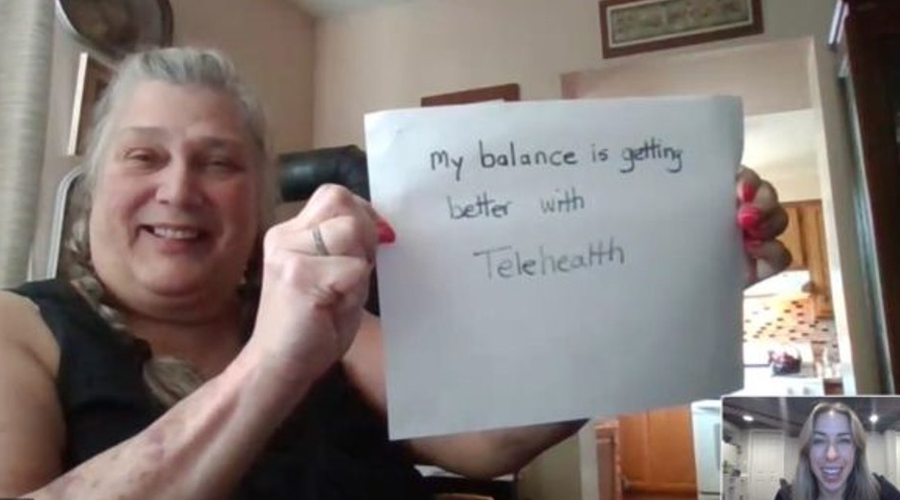
Jennifer: Clinically, Virtual House Calls can foster independence with functional mobility faster. They promote higher compliance with attending appointments and carrying over strategies and learning during skilled services. They also decrease barriers to accessing healthcare.
Kim: Patients report increased comfort in discussing some difficult or embarrassing topics through a computer, including incontinence, memory frustration, etc. Virtual care can also be performed when a patient or clinician is ill or immune-compromised.
9. How have patients responded?
Nicholas: Very well. I have lost count at this point of the number of patients who were very hesitant about the idea at first and ended up loving it.
Jennifer: For the most part, responses have been extremely positive. I have had a few encounters where we transitioned to in-person services because the tech was difficult for its users, but aside from this minority, my patients have expressed that they love virtual care services.
10. What’s your favorite part of Virtual Care?
Nicholas: My favorite part is the flexibility. It is very easy to move a virtual schedule around since it is not based on location compared to an in-person visit.
Jennifer: This is a loaded question! I have loved the clinical learning journey that this has opened for me. I love that I have met patients from New York, Maryland, and other parts of New Jersey that I otherwise would not have met. I am working with an incredible virtual team with FOX, people I probably would not have met or had the opportunity to interact with otherwise.
FOX Rehabilitation’s Virtual House Calls represent a significant advancement in healthcare delivery, blending technology with compassionate care to enhance patient accessibility. The insights shared by FOX’s Virtual Care Specialists illuminate the many benefits of this innovative model, including improved patient outcomes, increased flexibility, and enhanced engagement for patients and their families. As the healthcare landscape continues to evolve, virtual care not only meets immediate needs but also fosters independence and empowers patients to take an active role in their health management. With continued advancements in technology and growing acceptance among clinicians and patients alike, the future of virtual healthcare looks promising, ensuring that quality care is within reach for all.