
How Clinicians Can Help Protect Older Adult Patients from Scams
By Shannon Stocks, MS, CCC-SLP Speech Language Pathologist LSVT LOUD Certified Clinician Pennsylvania Southeast
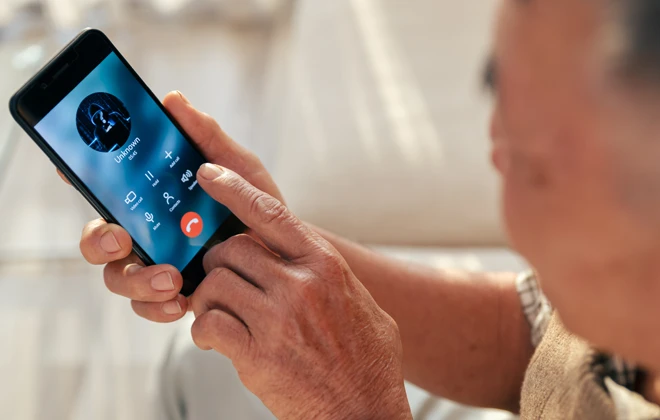
On a summer afternoon, I am welcomed into a patient’s apartment and the phone is already ringing off the hook. Nothing unusual—family and friends alike check in on this beloved couple every day. Yet, as I make my way into the dining room to sit down with the husband and begin my usual chit-chat, my ears perk up at the sound of the phone conversation in the next room. “Slow down… what happened? Oh, darling, are you alright? You sound different.” A pause. “Oh, because you broke your nose. And that was from an accident? Hold on, you say you need how much?” I bolt from my chair and position myself in the doorframe, within the wife’s line of sight. “Wired directly? Where are you, honey?” With each statement, goosebumps rise along with my unease. I motion emphatically for the wife to stop and hang up the phone. She raises her gaze to mine and shoots a knowing grin. “Well, I don’t know who you are, but you are certainly not my grandson. I hope you’re really proud of what you’re doing here. Goodbye now.” As she clicks the kitchen phone back into place, a sense of relief washes over me. Whether it was my presence in the doorway or the wife’s quick thinking, this couple ostensibly avoided a scam. But would others be so lucky?Educating Older Adult Patients About Online and Phone Scams
Technology is everywhere. A smartphone is found in nearly every purse and a laptop in almost every living room. Households are encouraged to make every sort of payment online or over the phone, rather than the traditional route of bringing a pen to checkbook paper. This increase in technology use is compounded by the number of outlets and inlets for communication, allowing for more opportunities for scammers to pop up, undetected. While working with individuals in the 65+ community, the higher level of susceptibility to scams has become clear. To begin with, the Baby Boomer and even Gen-X populations may have less familiarity with technology. Medical comorbidities, changes in vision, hearing loss, age-related cognitive decline, and limited caregiver support can exacerbate issues and bring a lower comfort level, even lower. For this reason, it is even more pertinent that we, as clinicians, acquire the tools necessary to educate our patients and protect these valued community members from scams. In this manner, we are preventing implications ranging from computer viruses to financial ruin.Identifying Scams Targeting Older Adults
Helping our patients identify a scam can be key to avoiding these types of scenarios. And a scam can be identified in a multitude of ways. Many scams via phone call may begin with a prerecorded message. Yet others may take a more personal approach, claiming to be a part of a familiar-sounding organization, or starting the conversation with something like, “this is your grandson,” rather than naming which grandchild is being impersonated. Scammers will try arduously to appear recognizable to gain trust and limit questions. Advise your patient to be aware of specific phrases. Commonly used phrases, whether in a scam email, text, or phone call, could include “prize money,” “specially selected,” or “limited time offer.” Additionally, there is typically pressure for immediate action during these types of calls, texts, and emails. Fraudsters may impose high-pressure situations, asking for action, usually providing personal information, before any verification can occur. And if concrete questions about the business or offer arise, the scammer is disinclined to answer. Most alarmingly, a scammer may request “confirmation of personal information” or verification for an address, phone number, email, credit card number, or even social security number. And, when asking for money, the scammer may ask for the cash in a very specific way, such as via money transfer, gift cards, wire transfer, or a private courier. When receiving false invoices or phony debt collection notices, threats of arrest in instances of non-compliance are also common. This type of extortion is reprehensible, yet avoidable when the red flags are pointed out to our patients.Affirmative Action in Instances of Suspected Scamming
While being aware of the signs of a scam is imperative, the response taken is equally as important. The following are ways in which you can encourage your patients to take action.- Block unwanted calls or texts. On an iPhone, select “phone” then tap the information icon (encircled lowercase “i”) and choose “block this caller.” On an android, tap the caller’s name, long-press the phone number, then tap, “block/report spam.”
- Register home and cell phone numbers for the National Do Not Call List at www.donotcall.gov or call 1-888-382-1222 (TTY: 1-866-290-4236).
- Block unwanted calls by downloading a third-party call-blocking app such as YouMail or TrueCaller.
- Browse the phone provider’s tools and services. Many major wireless providers such as Verizon and AT&T offer solutions to build call filters into an existing device.
- Block hackers from devices and optimize online privacy with services such as Norton or McAfee.
- Use a reverse number search to see if anyone has previously reported the caller as spam, with a website such as Unknown Caller.
- Report scams to the Federal Trade Commission or FTC.
Spread the Word
While my patient’s wife thought quickly on her feet that summer afternoon, that fraudulent call was neither her first nor her last. It is critical to reiterate the aforementioned ways to identify a scam and respond to one. Resisting the pressure to act immediately in these circumstances can protect life savings and emotional hardship. Emphasize to anyone you may suspect could be at risk, to always take a moment and speak to trusted someone before giving away any personal or financial information.Recent Articles
-

Stay Strong This Fall: Why Movement Matters More Than Ever
Fall has a way of quietly shifting our daily routines before we even realize it. As daylight fades earlier and the weather turns cooler, outdoor walks become less inviting, holiday planning picks up, and we naturally spend more time indoors. When these seasonal shifts happen, our overall physical activity can quietly drop right alongside the temperature. -

Beyond Balance: Dynamic Strength for Fall Prevention
When discussing fall prevention for adults over 50, standard advice almost always centers on environmental modification: clearing cluttered hallways, removing loose throw rugs, improving indoor lighting, and installing bathroom grab bars. While these precautions are a vital first step in making a home safer, environmental fixes address only one side of the equation. -
FOX Rehabilitation’s Jason Hazel Elected to Argentum Board of Directors
FOX Rehabilitation is proud to announce that its Chief Growth and Strategy Officer, Jason Hazel, PT, DPT, has been elected to the Argentum Board of Directors, joining a distinguished group of senior living leaders committed to advancing innovation, operational excellence, and compassionate care across the industry.