
Regaining Function After Hip or Knee Replacement
By Elizabeth Lamay, PT, DPT, CLT
It is estimated that over 1 million Americans undergo hip and knee replacements each year to help reduce pain associated with functional mobility and improve quality of life. However, these post-operative outcomes are not guaranteed, and physical therapy plays a critical role in ensuring positive results after surgery. Optimal treatment interventions are essential to help patients achieve the best possible success in returning to their prior level of function. As a seasoned clinician, I offer the following tips for regaining maximum function after hip or knee replacement.
Pre-Operative Physical Therapy
There is great benefit to a short course of physical therapy before a hip or knee replacement. It is common to have deficits in muscle strength and joint mobility before surgery, as our body will avoid putting more strain on a painful joint. The muscles surrounding the joint will get less use and weaken, and the capsule surrounding the joint will tighten. Physical therapy treatment will be helpful in maximizing lower extremity strength and knee range of motion, which will result in better postoperative outcomes because the patient will be stronger going into surgery. Physical therapists are knowledgeable in providing exercises that will decrease limitations without adding additional pain. We can also provide education on what to expect after surgery, so patients are well informed of realistic timelines for regaining function.
Pain Management
Many people are excited to resume their prior level of activities after surgery, but that can be limited by pain. Post-operative pain can be managed in part by medication; however, education is needed to ensure that a patient’s daily activities are not contributing to their level of pain. Our thorough evaluations will pinpoint household activities and work tasks that may need to be curtailed or reduced until pain levels are more manageable. It is likely that if we “push through the pain,” it will take a few days to a week to recover, allowing frustration to set in. Physical therapists will educate patients on the need for movement throughout the day, but also for adequate rest. Additionally, physical therapy can provide education and training to patients on proper body mechanics and optimal technique to safely participate in meaningful activities.
Regaining Range of Motion
Part of physical therapy treatment after surgery will focus on regaining range of motion in the replaced joint. It is crucial to regain most joint motion within 6-8 weeks post-surgery to avoid limitations from scar tissue formation. Function will be impacted if the full range of motion is not attained, as proper gait requires full knee extension, and stair negotiation requires full knee flexion.
Initially, range of motion is likely to be limited due to postoperative swelling and sometimes pain. A physical therapist will aid patients in increasing motion through manual techniques like passive stretching and joint mobilizations, but also through active exercises that the patient can perform at home.
Improving Strength
It is common for the muscles surrounding the joint replacement to fatigue easily after surgery. Addressing muscle weakness is important for two reasons:
- To avoid compensatory movements
- To perform our daily activities with less pain
A physical therapist can provide a guided and progressive strengthening program that is individualized to a patient and their goals. Progression throughout the course of care is important to avoid plateauing, as well as to minimize the risk of overuse injuries. An individualized plan is important as well, as no patient has the same limitations post replacement, and a custom exercise program will certainly provide better outcomes.
Avoid Rushing Progression
It is understandable for frustration to set in after experiencing years of pain before surgery and now, post-operative pain. The function has likely been limited for a long time, and now that the surgery is done, patients are ready to get back to their activities without restriction. Because of this, we often see patients wanting to rush their progress. Physical therapists can be great educators in explaining why it is important to stick to a steady plan. Many patients are surprised when educated on healing timelines, as it takes strength at least four weeks to improve, and up to twelve weeks for the soft tissues and bone to heal post-surgery. Below are a few examples of how pushing progress can result in difficulties down the road.
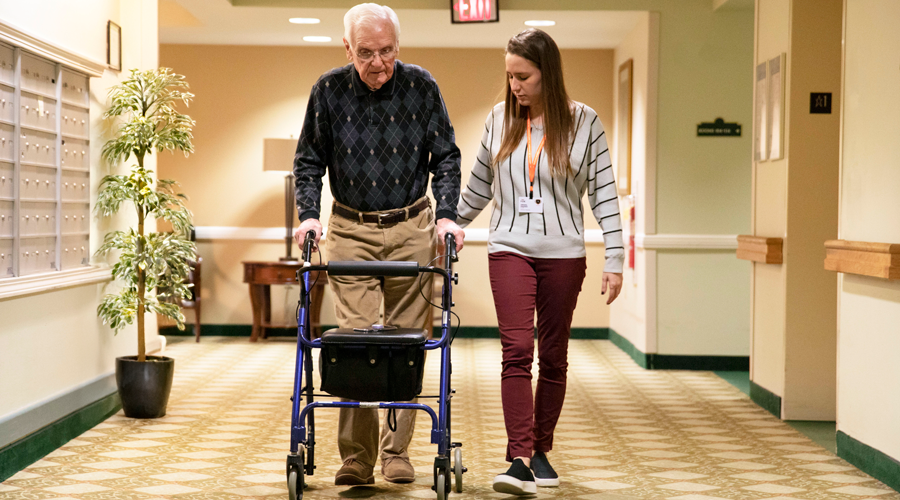
- Patients are quick to reduce assistive device use. We often see flare-ups of pain due to increased strain through the replaced joint, as well as gait deficits like a limp. Once a gait abnormality has taken place, it is more difficult to correct improper form and, in time, leads to overuse injuries.
- A repetitive exercise plan can get monotonous and cause patients to want to increase the difficulty of their routine. When too much load is applied to a muscle that cannot tolerate it, we again see form deficits that lead to compensatory movements. If regression of the exercise does not occur, a patient will be exercising muscles that are used to compensating and not strengthening where their true weaknesses are.
In summary, physical therapists are valuable resources for guiding patients through recovery and helping them regain optimal function. Without proper instruction in pain management, exercise progression, and support in restoring range of motion, patients are more likely to experience difficulties later on. We play a vital role in a patient’s journey to full recovery!