
Grip Strength: More Than Just A Measurement
By Jen Ruoff, MS, OTR/L, BCG
Director of OT Clinical Services
As the generation of baby boomers continues to grow, healthcare needs to proactively engage older adults towards functional wellness. This focus on functional wellness can help prevent frailty, reduce healthcare spending, and allow for successful aging.
According to an article titled “Screening for frailty in primary care: Accuracy of gait speed and hand-grip strength,” frailty is associated with functional impairment, mortality, higher risk of adverse health outcomes, and emergency room visits and hospitalizations.
As one ages, overall vulnerability to early frailty increases. Yet, frailty has the potential of being dismissed as normal aging.
What if frailty could be measured in less than one minute?
What if that measurement could predict mortality, functional status, and physical performance in older adults?
Would you embrace it?
I hope the answer is a resounding yes.
THE SPECIFICS OF GRIP STRENGTH
Grip strength is a measurement that I feel all healthcare professionals should be taking the time to administer, interpret results, and develop a health plan for older adults to achieve in order to move towards functional wellness rather than just medical sustainability.
Grip strength takes less than a minute to administer and can be measured with the use of a dynamometer, costing anywhere from $30 to $300. The investment is so small when you think about the positive effects it can have on so many people.
THERAPY’S ROLE
As physical and occupational therapists, we are prepared with knowledge to be a part of the primary care team to align the vision of the healthcare movement and assist in giving older adults the tools to age gracefully and combat frailty.
We need to apply this knowledge and use the research to guide our clinical applications to define the value of our services.
Assessing grip strength gives healthcare professionals the ability to manage conditions with the appropriate interventions. Hopefully, this improves the management of conditions, thus reducing frailty. A 2003 study published in Age and Ageing relatedly states, “Loss of grip strength is associated with increasing chronological age and appears to be a powerful predictor of disability, morbidity and mortality.”
REAL-LIFE RESULTS
As a board-certified geriatric occupational therapist, grip strength is an outcome measure that I perform on every patient. This measure provides me with the clinical information needed to prescribe my plan of care.
When I share with my patients the impact of grip strength on their overall function, they are amazed and often motivated to work hard so the next time I assess them, the number increases. I see a fire ignite because they want to do better. They want to be stronger. They want to live life in control of their destiny.
This simple tool also gives me the opportunity to educate my patients on the importance of self-management and compliance with their prescribed home exercise program because muscle strength is closely related to regular physical activity. Grip strength also has a high correlation with other muscular strength measures (elbow flexion, knee extension, and trunk flexion and extension), which shows that it may be representative of overall muscle strength.
Lack of muscle strength has the potential to lead to falls, hospitalizations, and functional limitations, which might closely relate to early death, especially with older adults.
Ask yourself this: if you knew poor grip strength was a predictor of risk of mortality, would you be motivated to exercise to improve your strength?
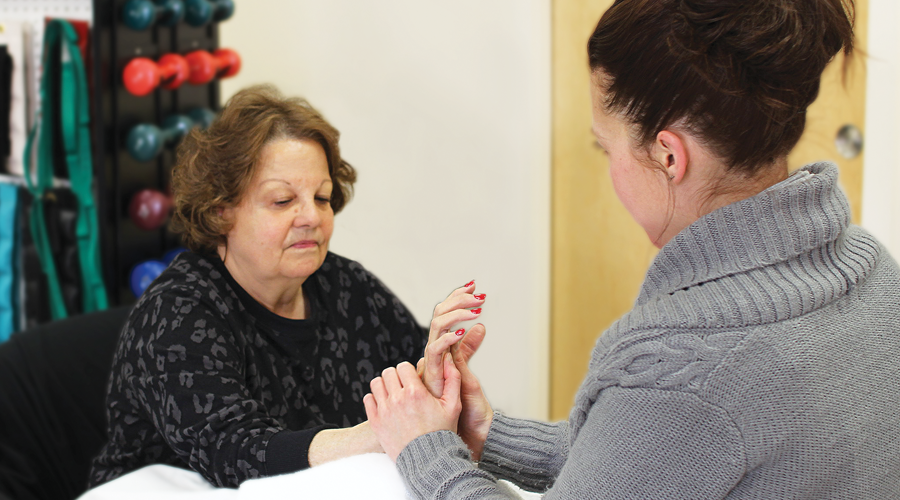
While the people in this photo are a real FOX clinician, patient, and partner, they are not mentioned in this article.