Transcript
Jimmy: Welcome to FOXcast: Physical Therapy, the Podcast for clinicians made by clinicians. It’s brought to you by FOX Rehabilitation. Find out more at foxrehab.org.
Hello and welcome to FOXcast: Physical Therapy, a clinically-excellent podcast. The purpose of this show is to have professional conversations around the care for older adults.
The show is brought to you by FOX Rehabilitation, a primarily clinician owned and operated private practice treating older adults. They offer physical therapy, occupational therapy, and speech-language pathology services in 15 states and growing. To find out more go to foxrehab.org, or follow them on social media for lots of valuable information for free on Facebook, Twitter, and Instagram — @foxrehab.
Our guest today is Dr. Will Dieter. Will is a physical therapist with a GCS. He’s also the director of physical therapy clinical services and the director of the geriatric residency at FOX Rehabilitation will welcome to the show.
Will: Hey, Jimmy. Thanks for having me. This is exciting.
Jimmy: Episode #1: you’re the start, no pressure.
Will: No, not at all.
Jimmy: So the reason we got together and we’re having a show like this is, just as I mentioned in the intro, to have professional conversations that that center around the care of older adults.
And, that’s what you do. That’s what you coordinate at FOX Rehabilitation.
So talk to me just a little bit. Just so the audience knows what your job is actually like with FOX.
Will: The older population is such a large percentage of the people that we see as a profession that we interact with. There just isn’t enough focus on them.
What I really do at FOX Rehab: we specialize what we call geriatric house calls, which is essentially a Medicare Part B model in the home, which we’ll get into a little bit more about that. But, I have the opportunity to guide the clinical practice of six or seven hundred physical therapists at this point in our practice and how they treat the older model in an evidence-based, proactive, efficient way.
So it’s a very cool job and something that I take a lot of pride in and our practice takes a lot of pride in.
Jimmy: So, you guys are making sure that the care you’re delivering from all your clinicians is, a phrase that we hear a lot, clinically excellent.
Will: Clinically excellent: I think at the forefront of clinical care pushing the envelope and making sure these people get the services they need the frequency the intensity and they are able to age optimally and age in place.
Jimmy: So specifically we can get into some really narrow areas of focus when it comes around the care of older adults. And, when we pass each other in the hallway, one topic that it kept coming up at FOX was patient adherence.
We focus on clinically excellent care but then the patients don’t adhere to their prescription from their physician. They’re not getting that clinically-excellent care. So, I think we should talk about where we currently are in the landscape about how patients get into the healthcare system to eventually see a physical therapist.
Will: You’re so correct. It’s when you define clinical excellence everybody goes to the evidence they go to, “I understand the concept. I understand that things are going on with these people.
And really the big piece that gets missed is adherence and people’s access to it and people’s willingness to do it, and the really clinically-excellent therapist is able to tap into that and be able to access that patient and also able to get them to adhere to what we’re doing.
Jimmy: What’s the percentage that you actually think people who were told that they should see a physical therapist by their physician and then who actually follow through on a plan of care?
Will: I’ve talked to a lot of physicians, and there’s no real number on this. Because you refer somebody to physical therapy, they don’t go: That paper prescription doesn’t get really logged anywhere. Nobody really knows exactly how many people go. But in conversations with physicians, I’ve heard that number that they say about half. So if you said to a physician: “how many people that you refer to therapy actually go?” They say about 50 percent.
In a model like ours, which again is an outpatient, Med B, home-based model. We see about 80 percent of the people that are referred to us which I think is a lot higher just by proxy of the model and the caliber of clinician that we have.
Jimmy: What’s the big difference? What are the reasons why? Because of the difference between 50 and 80 that’s a pretty big difference.
Will: Before we even get into that piece, I want to set the stage a little bit, and then we’ll talk about that.
When you’re talking about older adults in the United States, the population of older adults over 65 increased almost 9 percent since 2000. The use of outpatient services has gone up about 5.4 percent. So it’s very easy to see that the population growth and the access to outpatient therapy are not moving at the same rate.
We have about a 40 percent difference of people actually accessing outpatient services. So my question then becomes: “Well, what is the reason? Is it that they don’t need it? Is it that they can’t access it? What is the reason?
We know with older adults that their life expectancy is increasing. We know the number of people over 85 is going through the roof. We also know, from some work by the World Health Organization, that it’s not that people don’t need the therapy. People are actually less functionally well at a younger age.
Jimmy: Wow. So they’re living longer but their function is lower.
Will: Exactly: We have a health care system that is being taxed more and more by a population of people that is getting to be 65 and older, that are able to do less, that are costing more to the system for a longer period of time. It stands to reason that doing something about those people getting them access, these people that they constitute 41 percent of all hospital costs, are just from the older population.
If you can do something about those people — get them access, get them adherent to therapy — you can have a huge impact on the healthcare system overall in this country.
Jimmy: So now we’re talking about health and we’re talking about another thing that interacts with health which is healthcare cost. We’re seeing that we can improve health, improve function, and decrease costs.
Will: All of those things: A lot of people think you can’t do all those things together. I think if you have the right model and you’re proactive enough and you have clinical excellence and you have a model that promotes adherence — and not just adherence during the plan of care but adherence after the plan of care: lifestyle changes, educating people in the home, getting to the caregivers, understanding their actual environment, not trying to simulate it potentially in an outpatient facility where, you know, I treated the deficit, you’re maybe a little bit better at lifting your leg up, or you’re a little bit stronger, or maybe your single stance bounces a little bit better, but really when you go back to try to get into your shower at home, you still can’t do it.
Jimmy: Maybe you are mocking that experience in an outpatient setting and you never actually attempted to do that.
Will: Exactly, and we know, and the literature is out there, task specificity in older adults is so important.
Myself, I’m 32 years old. If I tore my ACL maybe and I went to an outpatient clinic, you could do quad strengthening and you could do all the things you’re supposed to do and I’m going to function better. But when you’re 85 and you’ve got six chronic conditions and you’re on multiple medications, that simulated and straight-played exercise: It doesn’t translate into an actual functional improvement the way it does and younger people. So being able to get into the home and actually do those activities really get you a better outcome.
And on the other side, going back to adherence, when you’re in the home — and it’s easy to access, it’s comfortable, and these people are seeing someone that’s working with the entire picture: working with all the psychosocial things — they want to do to therapy. And, that’s where a lot of the adherence comes from.
In typical outpatient, 60 percent of people make it more than six visits in a regular outpatient. So 40 percent of people on average are out by six visits. And part of that is maybe they just don’t need more than six visits, but a lot of it is they don’t always see the benefit as much as they could.
The people that we see: it’s about 84 percent of our people are seen for more than six visits because you go there, they start to see the improvement, they see you becoming ingrained in their lives and changing their lives, and they want to do it.
Jimmy: That’s got to be a great feeling: To hear that from the people that you direct, from seeing that with patients that you see, is your coming into their life and you’re improving their function. You’re solving their problem at the very end result.
Will: You are solving their problems and they are an active participant in what it is that you’re doing.
You’re working with them to get them to the point, things like: I remember when my very first patients. It was, “I want to be able to get to my grandson’s wedding. I want to be able to walk down the aisle.
That was the goal.
We got her there.
There wasn’t anything more important to her in that family than that. Having that peace is what builds that adherence. The 80 percent on the front end is mostly just because we’ll go out to you and because we’re proactive. But the fact that almost 70 percent of people make it through their plan of care, to the very end, which is a lot higher than most outpatient numbers are, That’s because of the quality of the care.
Jimmy: Talk about that specifically. You know the classic quote from Tim Fox, the founder of FOX Rehabilitation, was, you know, “How many 83-year-olds do you see in an outpatient clinic?” So the fact that we turned it on its head and said, “We now do PT house calls, but there’s got to be little more than that, like you said, just coming to them is a big, big difference, but there’s got to be some other clinically-excellent components to that.
So let’s talk about what those things are.
Will: Part of it is the fact that we will come to you. There’s an access piece there. There is a cost aspect to it as well. It’s an outpatient Part B benefit, which to the system is less costly and also, potentially, to the patient depending on the situation can be less costly as well.
So there’s that piece of it and there’s also the piece, and this is sort of the forgotten piece, and the part that we as a professional don’t do a good enough job of is the proactive part.
We are out there to physicians we know gate speeds are a predictor.
We know grip strength is a predictor.
We know there’s a lot of different pieces out there that, when they start to show symptoms or they start to show decreases in certain screening tools, we know there’s an issue brewing.
Everybody’s so focused on everyone’s medical health. They want to make sure that their blood sugar is good and that their blood pressure is controlled. Nobody’s really focused on how they’re actually functioning. And it becomes: They’re medically well, but they’re functionally sick.
And then what happens is, oftentimes, those people are not accessing services because they can’t, or maybe it’s the cost, or whatever it may be, and they’re the ones ending up in the hospital, ending up in more costly aspects of the healthcare system because they’re missing this piece. This model fills that. It allows you to be proactive and stop an issue or maybe delay an issue before becomes a full-blown problem.
Jimmy: Everybody in the system wants you to stop the issue before it becomes a problem. The patient or the client definitely does, but they might not see that coming, so the rest of the healthcare system: the physicians, the physical therapists, the third-party payers, the insurance companies, well, they definitely love you to prevent an issue before it happens.
I love that phrase that you used medically well but functionally sick. The first time I heard that I had to say, “Just wait, wait, wait, stop. Do that again. Oh yes, you are medically stable, but you can’t get to the grocery store by yourself. That is functionally sick. Talk a little bit about that and how FOX can turn that around.
Will: You know, it’s got to be a fundamental shift in the medical world. We have certain physicians we work with that get it. They understand that concept, and we are able to get to people sooner. And when we do that, and I look at a lot we have a lot of data in our practice, when we’re able to do that, the plans of care are shorter. They’re more specific. You’ll see real differences in nuances between that person’s specific condition.
When you wait too long and everybody’s got diabetes and COPD and they’ve fallen five times, at that point, it always is going to cost a little bit more. This service has become a bit more generalized because everybody sort of has a whole bunch of different issues. The efficiency just isn’t as good. The quality of that care is great because it’s necessary, but being more proactive allows you to be a little bit more specific in what you’re doing for that person, and hence, getting them to a higher level and optimizing their function.
We use the term a lot slippery slope of aging. It’s a lot harder to push somebody back up that slope after they’ve kind of fallen down the mountain than it is to have them start to maybe trip a little bit and we kind of just steady them before we’ve got a big issue.
Jimmy: Ounce of prevention, a pound of cure. When you go when you talk to a physician, I’m sure if you have studies that you can cite, that’s great. I’m sure if you speak really well and you seem passionate, that physician is going to see the passion coming from you and maybe refer patients your way or at least understand what you’re saying.
But you mentioned something just a second ago which is data. You see so many patients. So talk a little bit about some of the data that can actually, we love to do this in health care and science, prove what you’re actually talking about. So, what are the things that you know because of how many clients you guys actually get to see at FOX.
Will: I think there are a couple of different things. So one is, this is something we’ve been doing for a really long time, individual victories.
“Listen, Dr. Jones, you know, Mr. Smith did really well. Here’s how much better he got.
Them talking to a physician about it, you showing them pictures: That’s one piece. That kind of pulls on the heartstrings a little bit. So there’s that.
There’s the client satisfaction, client experience. That’s sort of the new, in vogue, at this point is: What was the experience? What was the value they felt? That’s the other piece. And we’ve been doing that for a very long time. You know we have quite experienced ratings in the upper 90s which I think has a lot to do with, again, the caliber of conditions that we have in the model.
But the other thing, really the data piece of it. This is where I think we as a profession have to, at times, step back a little bit and look at the broader picture. We get so hung up on things like the BERG, the TUG, the six-minute walk test. These are all wonderful tests. I am not saying they are not important, and they certainly have their place. But when you’re talking to the global healthcare system, they don’t want to hear about the proxy for the fall or the proxy for the hospitalization. They want to know: did the person fall? Did the person get hospitalized? What were the cost savings from a global perspective?
And so we have a lot of data that shows dramatic improvements in those tests. We have a lot of data that shows a lot of improvement in G-code levels. Again, it’s all good, but it’s sort of PT-centric.
We’re working on, and we’re getting very close to, really capturing actual falls data and actual hospitalization data. But the way the healthcare system is and that how fragmented it is, it’s really hard to get that unless you’re in an ACO which is a little bit different. So, we’re working on that, but we do have a program that we do here at FOX called FOX Optimal Living. So essentially what it is it’s a controlled environment in senior living where we track everything and we have control over just about everything as well.
When you look at that you look at the clinical programming, we’re talking about 40 percent reductions in falls. We’re talking about almost 30 percent reduction in hospitalization. Those are the real key numbers and the things that at the end of the day are really the most meaningful because obviously, they have a negative impact on quality of life and everything else. So I think we have to step away a little bit and look at the larger scale, especially when you’re talking to the healthcare community.
Jimmy: Yeah and we could do an entire, and I’m sure we will do an entire episode, just on falls and falls prevention and what happens after that fall. But I think you’re right: As soon as you go to that global community, everybody in the healthcare system understands, when you’re talking about working with older adults, preventing that fall is paramount.
If you can show data on how you can do that, now it’s not a sales pitch, it’s not a presentation, this is data that we have over hundreds and hundreds and thousands and thousands of patients that you can show us that says, “By doing this, by using these steps and this model of care, we will reduce this one thing in terms of falls amongst other things that will directly impact all of the things that have to do with the patient’s life, as well as the rest of the system which is cost and over-taxation of the system because, as we opened up the show with, the older adult population is living longer and thus is going to be a larger portion of society.
The issue of healthcare costs and managing the older adult is not going away. It’s going to get worse, and we need to have solutions, and we need to have solutions soon, to not only stabilize it but stop it from getting even more out of control in the future.If this sort of model took off, and not only as the first frontline care, so by that I mean the person’s maybe having an issue and they come straight to outpatient, but also things like in conjunction with home health. It’s just a continuum of care.
Say somebody does get hospitalized. Then, they go through the system, and everybody is being pushed out of the hospital sooner. They’re more acutely ill. There are a lot of regulatory reasons for that. They’re landing in-home health or maybe even back in the senior living community. Five years ago, they would have still been in probably a SNF or a sub-acute somewhere.
So having even that extra outpatient piece after home health, maybe that person is not technically home-bound anymore, right, but they’re not going to go to an outpatient clinic either. They’re not really where they need to be. You become the tail end of that continuum as well. So, I think I see it being proactive, sort of direct referral right to us but also it’s just the end of the continuum. We’ve ran some numbers, and if you could get some of the improvements that I mentioned before, if you could get something anywhere close to that in a larger number of people, You’re talking about billions of dollars in savings to the government, to Medicare, to this system, if you could implement something like this large scale.
Jimmy: If you had to narrow it down, what would your Mount Rushmore of improving patient adherence to a plan of care for physical therapy be?
Will: I tell clinicians all the time coming into our practice is: Spend a little extra time on the front end, really educating that patient, setting expectations, making sure they understand what you can do for them and what you can’t do for them.
What you don’t want is them thinking that the results are going to be A, and you know full well the results are never going to be that it’s going to be something different. Not having expectations are aligned is a problem. So the first thing is a little bit extra on the front end to make sure they know what the expectations are.
The second thing would be, obviously, and I’ve said this before, really involving them in the process: having them help you with the goal setting, asking them how they feel like they’re doing, asking them how they feel like I’m doing as a therapist, what can we do better. Always that collaborative approach builds adherence, and it’s also going to build better outcomes.
I think our model, the model of being in the home the access part of it, and being able to dose support for the under Medicare Part B, is probably the third piece that is very important.
The last piece really I think is just continuing that conversation all the way through and making sure that there are clear expectations and communication on what are we going to do after the plan of care, what am I expected to do.
If they can’t do what you want them to do, make a plan B. I tell clinicians that all the time. You giving them a home exercise program of 10 things and they’re not doing any of it or not knowing what the most important thing is isn’t going to help anybody. If you got to give them two exercises, the research supports this, and that’s the biggest bang for the buck they’re going to get, do it and make sure they know where to go. Make sure they know when I sort of have this problem, I’m calling you.
They know they know the warning signs so they don’t fall down that slippery slope again.
Jimmy: I love that. Will Dieter’s Mt. Rushmore of improving patient adherence: setting expectations early, involve the patient in the process, access to the patient and bringing it to them, and then evaluating the course of care and beyond, “where does it go from here?” I love that, love the fact that we brought this topic on the first episode. There’s going to be many more. We appreciate you taking your time out to help educate the rest of the healthcare system on how to improve patient adherence.
Will: My pleasure thanks for having me.
Jimmy: Thanks for listening to FOXcast: Physical Therapy, a clinically-excellent podcast. It’s brought to you by FOX Rehabilitation. Listen to other episodes or read articles and position papers at foxrehab.org.
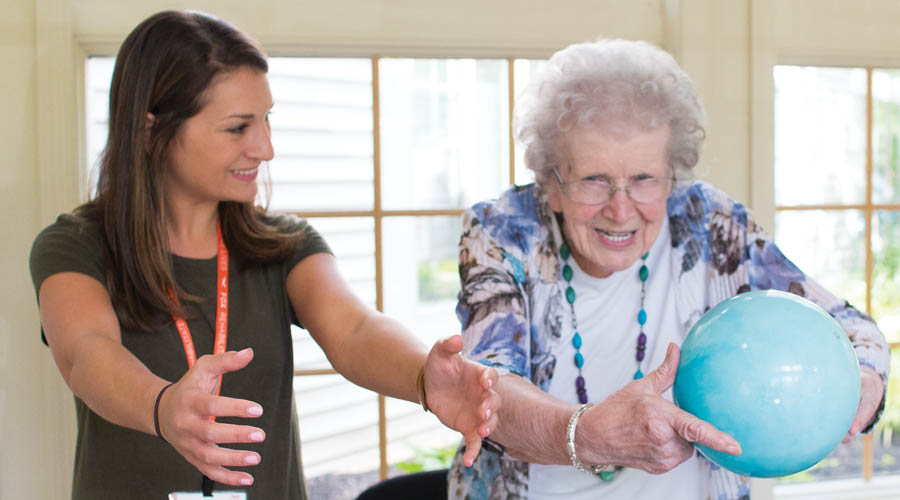
While the people in this photo are a real FOX clinician and client, they are not mentioned in this article.