
Communication Is Currency
By Jimmy McKay, PT, DPT
Director of Communications
In physical therapy school, we learn from a vast array of topics: anatomy, physiology, differential diagnosis, and pathology. We learn how to properly prescribe and dose exercise programs to our patients. This gives them the best opportunity to achieve what they once thought impossible: optimal function.
What isn’t on the syllabus often enough is how to effectively communicate everything we know to the people who need it in a way they can best understand it.
Therapy demands a much more active role on the part of the patient versus other interventions, like medication. This highlights the importance of communication in the relationship between therapist and patient.
Understanding and reflecting on your communication skills can pay off within your patient/therapist interactions. Communication is a currency for a therapist, and here are some ways to make our communication more valuable:
Know Your Audience
Patients are people, and people are vastly different. Focus and attention need to be placed on the things that make your patient unique. Where demographics like age, sex, gender, and ethnicity should be paid attention to, specific psychosocial factors like stress, hostility and depression need to be factored into knowing your audience.
Patients with the same diagnosis might appear to be similar on paper, but many other factors outside of the diagnosis make the patients completely different.
Make sure you take the time and effort to know as much about your audience as you can. Take note of their verbal and nonverbal responses in your interactions and begin to cater your communication during their treatment to how they respond.
Talk In Their Language
Some people talk fast while some have a slower cadence. Some people are quiet talkers while some can be heard from down the block. Some are reserved while others are very outgoing.
How we communicate with others is as unique to us as our fingerprints. Recognize what ways your patient communicate and in turn what ways they would be most receptive of receiving your communication. Recognizing and adapting your treatment to their communication styles can further enhance their therapeutic experience. Learning styles vary in forms such as auditory, visual or kinesthetic to name a few. Crafting your message in a style that is easily understood by your patient increases the likelihood that your message is understood.
Listen
A study from the National Institutes of Health showed that patients are interrupted just 12 to 23 seconds into their subjective examinations. The patient has a vast amount of information that is valuable for determining why they are seeking treatment. But often, healthcare practitioners stop the flow of information from the source in less time than it takes to make toast.
Listening Versus Hearing
The word listen appears on our list twice, so that must mean it’s important.
There is a difference between listening and hearing. Here is how you can easily remember the differences: I have heard what Charlie Brown’s mother sounds like, but I’ve never been able to listen to her. Side note: Perhaps, she has an issue that our speech-language pathologists can assist with?
Employ active-listening techniques to make sure your audience knows that you are listening to them. During your patient’s subjective exam, while they are speaking, do simple but important things such as:
- Maintaining Eye Contact
- Smiling and or nodding to show understanding
- Employing mirroring behaviors
- Using a body language that suggests that they are your focus
Once your patient has finished giving their subjective statement showing them that you not only heard them, but you also listened can be done in a few ways:
- reviewing a few key points of their story
- questioning any points that need clarification (remember to allow them time to fully respond)
- summarizing their story back to them, to allow anything you might have misheard or not remembered correctly
Using these techniques says a lot without you having to speak. It tells your patient that you are there for them, they are your focus, and that they are an important part of their rehabilitation. all All factors which build a strong therapeutic alliance. Compare this to cutting them off early and telling them what they have to do because you believe you know more about them and their needs. They are there for your expertise, not to be talked down to or ignored.
Be Honest
Honesty is a relationship maker or breaker in patient care. Dishonesty, or even a hint of it, leads to the loss of trust. If your patient doesn’t trust what you’re saying, do you really think they’ll do anything that you suggest?
Keep in mind that “I don’t know” is a great answer if you don’t know the answer to a question from a patient. Following it up with, “But, I will find that answer for you,” is a great example of how to build trust and a therapeutic alliance.
Clear and honest expectations from initial encounter throughout the term of care is a great way to manage expectations. When you keep a clear dialogue on what is expected by both parties, the opportunity for miscommunication is reduced.
Short & Sweet
Figure out what you need to say, how you’re going to say it and then do just that — nothing more.
We don’t get paid by the word, using too much information can overwhelm your audience. So, aim for clarity and brevity where possible.
Silence
While treating, sometimes we might feel the need to fill the empty space of silence with words. This can be during a subjective examination, while you’re teaching or observing your patient’s movements, or any point during treatment.
Silence can actually say a lot, while also allowing another form of communication to take place: nonverbal communications such as body language. As therapists, do we need to spend time here explaining why body language is an important form of communication?
From The Words Of A Leader In PT
During his Pauline Cerasoli lecture in 2017 at the American Physical Therapy Association’s Combined Sections Meeting, Duke University Chair and Professor Chad Cook, Ph.D., PT, FAAOMPT, asked this question, “Does cognitive intelligence drive improvements in our profession, or is this more an issue of passion and the gifts associated with communication?”
We should aim to improve all facets of our skills as therapists, but don’t forget that how we interact with our patients can be just a valuable.
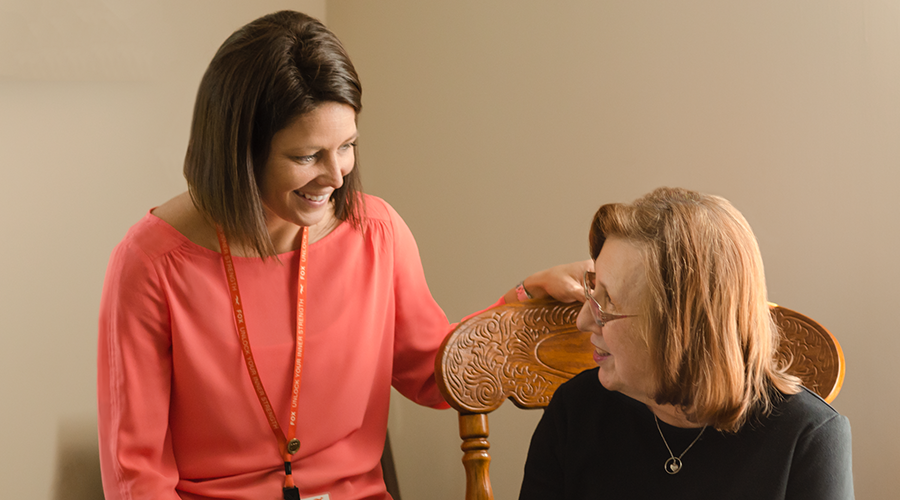
The FOX clinician and patient in this photo are not referenced in this article.