
Speech-Language Pathologists — What’s Our Worth?
By Maureen Colket, MA, CCC-SLP
Speech-Language Pathologist
As speech-language pathologists, we are regularly explaining our practice to patients, caregivers, and other medical professionals.
Have you ever introduced yourself to a patient as the “speech therapist” only to hear, “I thought my speech was fine,” as their response?
This has a lot to do with the lesser frequency in which patients receive treatment from SLPs as compared to physical and occupational therapists. However, it remains our duty in this field to further the profession and continue to make a name for ourselves through performing at our best and proving our value in the ever-changing world of health care. Educating our colleagues and patients is a big part of these responsibilities.
THE ROLE OF THE SPEECH-LANGUAGE PATHOLOGIST
The American Speech-Language-Hearing Association regularly updates its Knowledge and Skills documents which list the qualifications required of SLPs working with specific patient populations, including this one: “Providing Services to Individuals with Swallowing and/or Feeding Disorders.”
The document lists the required knowledge and skills of an SLP as they pertain to the identification, assessment, and treatment of dysphagia. For example, Role 2.0 is “Conduct a clinical examination of the upper aerodigestive tract.” This includes the following: “knowledge of any special medical condition (e.g., pulmonary dysfunction, tracheostomy, neuromotor involvement) that may have an impact on an individual’s feeding and swallowing.”
That is a tall order.
SLPs need to know a lot about many varied and complex medical diagnoses. The same level of knowledge and skills is required when we are treating patients for cognitive-linguistic disorders. If there is a new diagnosis you encounter, rather than feel discouraged, look at this as an opportunity to expand your knowledge.
It is not enough to see a patient coughing and recommend a diet downgrade or to select a random divergent naming task for a patient with cognitive-linguistic deficits. If we do not want to be seen as therapists who simply feed patients and change their diets or those who play word games with patients, then let’s be better than that.
The good news is that we are better.
We already have a broad spectrum of knowledge along with the skills required to address therapeutic intervention. Certainly, we must always continue our education, read the literature, and strive to make our practice truly evidence-based. But along the way, we need to advertise our knowledge and skills a bit better even to those closest to us: our valued physical and occupational therapy counterparts.
Every PT and OT has had different experiences when it comes to SLPs: Many PTs and OTs can name speech, voice, swallowing, cognition, and language as treatment areas in seconds flat.
However, consider a new graduate in one of these roles or a new perspective you can bring to a seasoned therapist. It is 100 percent appropriate to educate your colleagues about your unique set of skills, including how you can help that patient progress even further with the addition of SLP to a patient’s plan of care.
WHAT DISTINCT VALUE DOES THE SLP OFFER?
The addition of SLP to a patient’s plan of care could be triggered by a variety of reasons: difficulty chewing/swallowing, following directions, finding words, or carrying over instructions, for example. PTs, OTs, and nurses, among other professionals, can and do refer patients to SLPs for these reasons.
Once you evaluate the patient referred to you, it is paramount to follow up with the professional from whom you received the referral as well as all other professionals and caregivers involved in the care of this patient for truly collaborative success.
You might think, “But, the PT and OT don’t treat dysphagia. Why do they need follow up for this?”
Consider the implications of positioning, energy conservation for meal time, and the fact that food and liquid is consumed at various times of the day – water break after exercising for example.
PTs and OTs recognize when patients have cognitive impairments. However, the SLP is the one who can break down the impairment into its components and develop appropriate strategies to improve performance in all tasks.
Let’s say a PT tells you her patient has difficulty following directions halfway through a session but reports no fatigue, pain, or other physical condition that would interfere with this ability. You might suggest that the PT follow the 90-second rule for cognitive impairment or provide instructions in short phrases, one step at a time to decrease the workload in processing information. In cases of patients whose communication is significantly impaired, development of a patient-specific communication tool (communication board or Augmentative Alternative Communication device) will require your skill set.
HOW DO I INTEGRATE THIS KNOWLEDGE INTO MY WORK?
Change your mindset.
Think like a physician and place greater value on what you do.
Focus on how to train your patients and their caregivers for success after your treatment course. This involves carefully developing a home exercise plan that will allow for carryover of everything you worked so hard to help the patient gain.
If you feel you are very strong in dysphagia assessment and treatment but get a little lost when it comes to language therapy for a patient with aphasia, attend a continuing education class (remember, there are many opportunities online now, so you don’t always have to travel) or tackle some journal articles.
Lastly, keep in touch with your colleagues. Share ideas and ask questions of other SLPs. As a FOX clinician, I am fortunate to work with an amazing group of SLPs. We get together for journal club meetings and keep in touch regularly via text and email if we have questions or want to share ideas. We all prioritize keeping our practice strong, relevant, and valued.
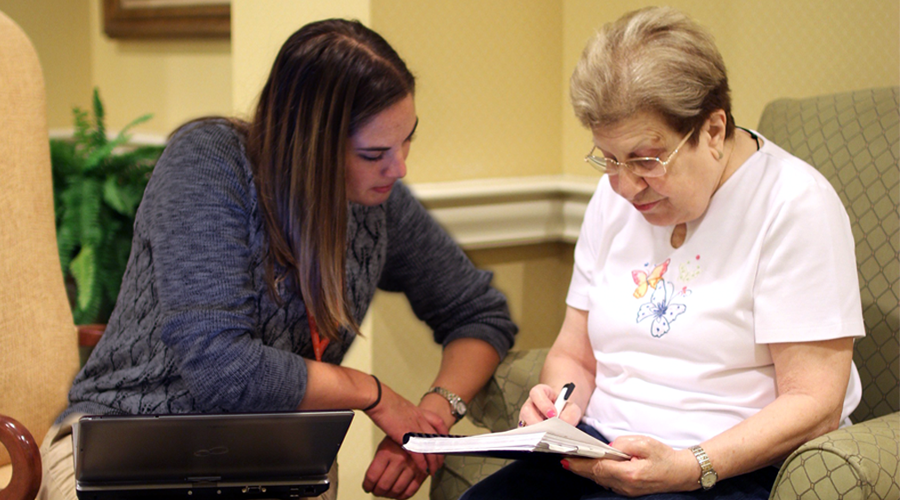
While the people in this photo are a real FOX clinician and patient, they are not mentioned in this article.